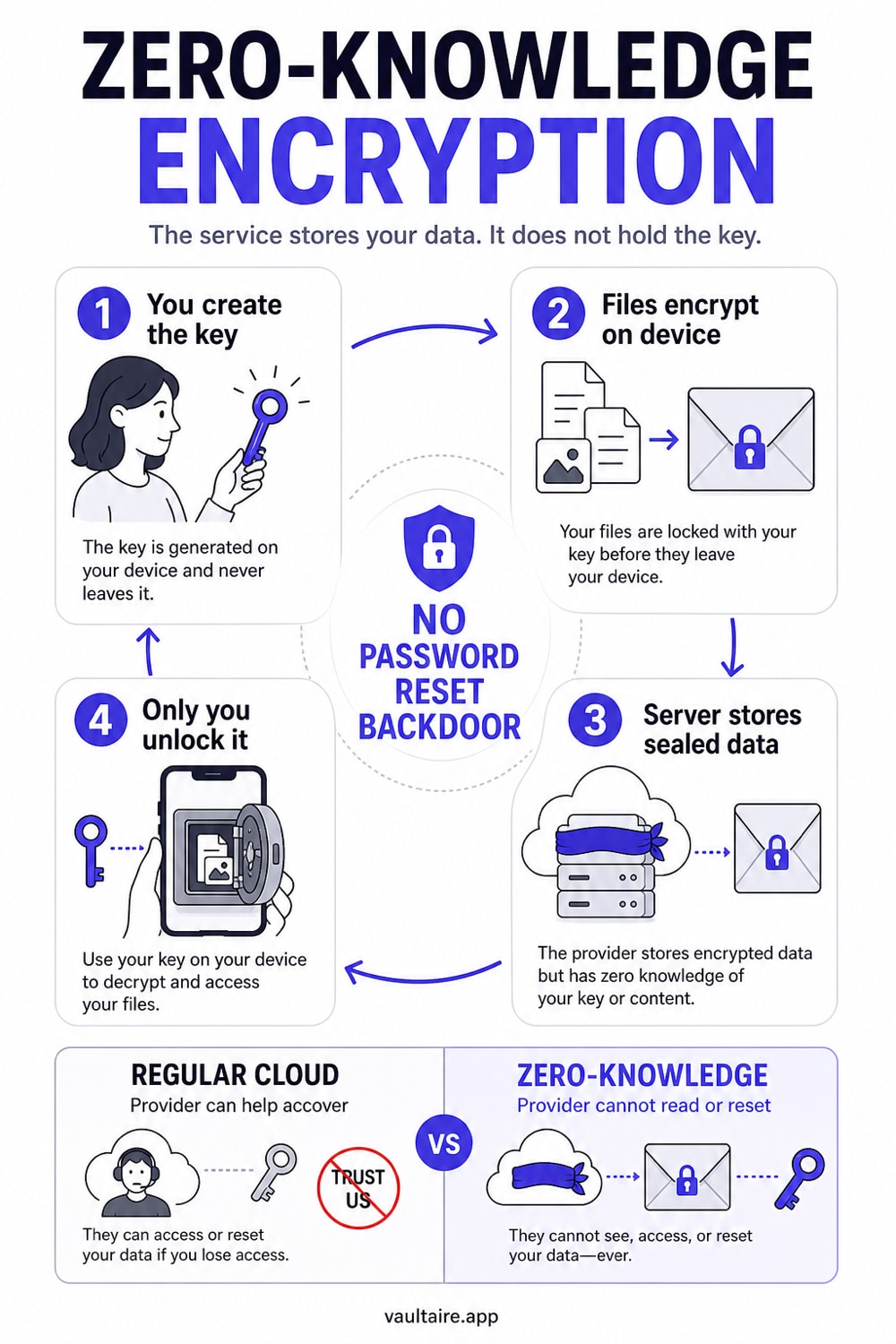
What Is Zero-Knowledge Encryption? A Simple Guide
Zero-knowledge encryption means the provider cannot access your data.
Zero-knowledge encryption is a provider-bounded architecture in which the service does not hold the key needed to decrypt stored user content. Unlike standard cloud encryption where the provider controls the content key, client-side encryption can keep that capability on user devices. A legal request, breach, or insider may still expose ciphertext, account records, traffic data, or other metadata the provider retains. NIST's key-management guidance makes key custody central to access, but the client app, operating system, and unlocked device remain part of the trust boundary.
How Zero-Knowledge Encryption Works
The simplest analogy: a hotel safe where only you set the combination, and the hotel never learns it. If you forget the combination, the hotel cannot open the safe for you. That is not a flaw in the design. That is the design.
In technical terms, zero-knowledge encryption works through three steps:
Key derivation on-device. The user provides a credential such as a password, passphrase, or pattern. A password-based key derivation function combines it with a salt to produce a key on the user's device. A well-separated design can use that key to unlock a random content-encryption key instead of encrypting every file directly with the human credential.
Encryption before transmission. All data is encrypted on the device using the derived key before it leaves the device for cloud storage or backup. The encrypted output (ciphertext) is what gets uploaded.
The provider receives no plaintext content key. Content keys necessarily exist in client memory during use and may also be stored locally or remotely inside authenticated encrypted envelopes. The provider can store ciphertext and wrapped keys without holding the user secret needed to open them. Account, traffic, record-size, and timing metadata may still remain visible.
The critical constraint: if the user loses every valid credential and recovery path, the encrypted content becomes inaccessible. Recovery can still exist, but its key custody must be explained. If an email reset alone restores readable content without an old-device approval, recovery phrase, recovery key, or equivalent user-held secret, the provider has retained an effective route back to the plaintext.
Zero-Knowledge Encryption vs Other Types of Encryption
The term "encryption" appears in marketing materials for nearly every cloud service. The differences between types are substantial.
| Type | Who Holds the Key | Provider Can Read Data | Survives Provider Breach | Example |
|---|---|---|---|---|
| No encryption | N/A | Yes | No | Dropbox (standard tier) |
| Encryption in transit (TLS) | Provider | Yes (at rest on their servers) | No | Google Photos |
| Server-side encryption at rest | Provider | Yes (they hold the decryption key) | Partially (depends on breach scope) | iCloud (standard) |
| Platform end-to-end encryption | Client devices and account recovery system | Not through the normal service path | Depends on client, recovery, and metadata exposure | iCloud with Advanced Data Protection |
| Provider-blind client-side encryption | Client and user-controlled recovery path | No provider-held plaintext content key | Content can remain encrypted; metadata and ciphertext may still leak | Encrypted vault and backup systems |
The distinction between "encryption at rest" and "zero-knowledge encryption" is the most commonly confused. With encryption at rest, the provider encrypts your data on their servers using keys they control. This protects against physical theft of the server hardware. It does not protect against the provider reading your data, a government subpoena for the data and keys, or an insider threat. The provider has the decryption capability.
With provider-blind client-side encryption, the service is not given the plaintext content key through the documented protocol. Stored ciphertext can remain opaque to that provider, while the client software, recovery path, account metadata, and software-delivery channel still require trust and review.
Why Zero-Knowledge Encryption Matters
Data Breaches Expose Billions of Records Annually
The Identity Theft Resource Center reported 3,205 data compromises in the United States in 2023, affecting approximately 353 million individuals. When a provider holds content keys, one breach may expose both stored data and a path to decrypt it. Provider-blind encryption separates those assets: a server breach may still expose ciphertext and metadata, but not a provider-held plaintext content key. Credential guessing and client compromise remain separate risks.
Legal Compulsion Is a Real Threat
Providers can be required to disclose data they retain. A provider-blind design can limit that response to ciphertext and available account, traffic, billing, or service metadata because the provider does not hold the plaintext content key. Whether another party can obtain a user credential, exploit a client, or compel disclosure is a separate question. Apple introduced Advanced Data Protection in iOS 16.2 as an optional expansion of end-to-end encryption for iCloud data.
"Trust Us" Is Not a Security Architecture
Server-side encryption relies on provider-controlled keys and policy. Provider-blind encryption changes the key custody so the documented service path lacks a plaintext content key. That is a stronger architectural boundary, but its force still depends on correct client code, authenticated software delivery, sound recovery, secure devices, and an implementation that matches the specification.
The NIST Standard Behind the Cryptography
AES-GCM was standardized by the National Institute of Standards and Technology in SP 800-38D (2007). AES itself was selected by NIST through a public competition in 2001. The "256" in AES-256 refers to a 256-bit key. Exhaustive search over a uniformly random key is computationally infeasible, but a human password or pattern can provide far less entropy even when a key derivation function outputs 256 bits.
GCM (Galois/Counter Mode) adds authenticated encryption, meaning the decryption process detects any tampering with the ciphertext. If a single bit of the encrypted data is altered, decryption fails rather than producing corrupted output. This prevents attackers from manipulating encrypted data without detection.
PBKDF2 (Password-Based Key Derivation Function 2), specified in RFC 8018, converts a human-provided credential into fixed-length key material through repeated pseudorandom-function calls. More iterations raise the cost of each guess. They do not add entropy to a predictable pattern or password, so credential choice and offline verification still matter.
How Vaultaire Implements Provider-Key Separation
Vaultaire is a client-side encrypted vault for iPhone. In the product sense often marketed as "zero knowledge," its narrower documented claim is that Wraxle does not receive plaintext vault content or the keys needed to decrypt it. Here is how the implementation and remaining trust boundaries work at each layer.
Key derivation. The user draws a pattern on a 5x5 grid of 25 dots. PBKDF2-HMAC-SHA512 combines that sequence with one device-wide Keychain salt for 600,000 iterations to derive a 256-bit vault key. The vault key authenticates the encrypted index and wraps a separate random 256-bit master key. Recovery information, including the pattern, is stored in an AES-GCM encrypted Keychain database rather than plaintext files or a Vaultaire account.
File encryption. Each imported file is encrypted with AES-256-GCM under the random master key. CryptoKit creates authenticated sealed boxes with fresh nonces, and the streaming format derives a distinct nonce for each ordered chunk.
Metadata encryption. File names, MIME types, dates, index records, and thumbnail data are also protected with AES-256-GCM. Vaultaire does not use ChaCha20 for vault metadata.
Key management. Vaultaire stores its device salt and encrypted recovery database as ordinary iOS Keychain generic-password items protected with the WhenUnlockedThisDeviceOnly accessibility class. Pattern-derived vault keys and random master keys are processed in app memory through CryptoKit. Locking drops active key state, but Swift and iOS do not support a guarantee that every transient copy is overwritten.
Vault discovery. The normal interface does not show a vault list. The storage format keeps one storage directory per vault. Someone with app-container access can therefore count vaults, although the directory names do not reveal patterns, names, or plaintext contents. See the full security architecture and pattern encryption explanation.
How to Tell If an App Uses Real Zero-Knowledge Encryption
Start with three quick tests, then verify the published architecture:
The forgot-password test. If email reset alone restores readable data, ask what provider-held mechanism recovered the effective content key. User-held recovery phrases, old-device approval, and provider-controlled resets are different designs.
The new-device test. If a new device restores readable content, identify the secret or trusted device that authorized it. Account login alone suggests a provider-controlled recovery path; a recovery phrase plus encrypted backup records can preserve provider-key separation.
The account test. An email address or phone number links identity to service metadata, but it does not by itself prove the provider can decrypt content. Inspect the key hierarchy, recovery design, client code or audit, metadata policy, and whether authenticated ciphertext permits offline credential checks.
These tests are filters, not a security proof. A coherent specification should name the content key, unlock key, salts, derivation parameters, authenticated-encryption format, nonce rules, recovery envelopes, local secret storage, cloud metadata, and the point where plaintext keys exist. Independent review is stronger evidence than a product label.
Frequently Asked Questions
Is zero-knowledge encryption the same as end-to-end encryption?
They overlap but are not identical. End-to-end encryption (E2EE) means data is encrypted on the sender's device and decrypted only on the recipient's device. Zero-knowledge encryption means the provider cannot access the data. A service can be end-to-end encrypted without being zero-knowledge if the provider generated or has access to the keys at some point. Zero-knowledge encryption is the stricter standard.
What happens if I lose my password with zero-knowledge encryption?
Your data becomes permanently inaccessible if every valid credential and recovery envelope is lost. A provider-controlled reset or master key would weaken the provider boundary, so recovery must be designed separately. Vaultaire uses a recovery phrase, a generated nine-word phrase or a custom one of at least six words, whose derived recovery key opens an encrypted vault-key envelope. The phrase does not regenerate or encode the key, and new-device restore also requires the matching encrypted CloudKit records.
Can law enforcement access zero-knowledge encrypted data?
A provider may have to disclose stored ciphertext and the account, traffic, billing, or service metadata it retains. Without a provider-held plaintext content key, that provider cannot use its normal service path to decrypt the content. Device exploitation, credential discovery, recovery copies, and compelled disclosure are separate routes whose legality and effectiveness vary by jurisdiction and facts.
Is zero-knowledge encryption slower than regular encryption?
AES-256-GCM performance does not depend on who holds the key. Password-based derivation adds work during unlock, and its duration depends on the algorithm, iteration count, device, and implementation. Applications should measure that cost on supported hardware and balance responsiveness against the cost imposed on each offline guess.
Does zero-knowledge mean the app collects no data at all?
Not necessarily. The term addresses the provider’s content-key boundary, not every data flow. An app may still process account data, analytics, crash reports, IP addresses, record sizes, timing, or other service metadata. Vaultaire requires no identity account. Its app analytics and crash diagnostics are enabled by default and can be turned off with “Share errors anonymously” in Settings. The documented event policy excludes vault contents, patterns, phrases, and decryption keys; the privacy policy describes the current collection and retention rules.
How does zero-knowledge encryption compare to Apple's Advanced Data Protection?
Apple's Advanced Data Protection (ADP), introduced in iOS 16.2, extends end-to-end encryption to additional iCloud categories and uses the Apple Account recovery model. Vaultaire encrypts vault contents on the device and requires no Vaultaire identity account; its iCloud backup, on by default, plus sync and sharing use client-side encrypted CloudKit records in the user's Apple account. Vaultaire also offers pattern-separated vault access and duress mode, with the storage and recovery limits described in its plausible-deniability documentation.
Summary
Zero-knowledge encryption is best treated as a provider-key-separation claim: the service does not hold the plaintext key needed to decrypt stored content. That is stronger than server-side encryption under provider-controlled keys, but it is not a claim that keys exist only in memory, that metadata disappears, or that every client and device compromise is defeated. Judge the product by its key hierarchy, recovery design, implementation, and independent review.