AES-256 Encryption Explained: What It Means for Your Data
AES-256 explained: how the cipher works, why 256-bit keys matter, what GCM mode adds, and what to check when an app claims AES-256 encryption.
What is AES-256?
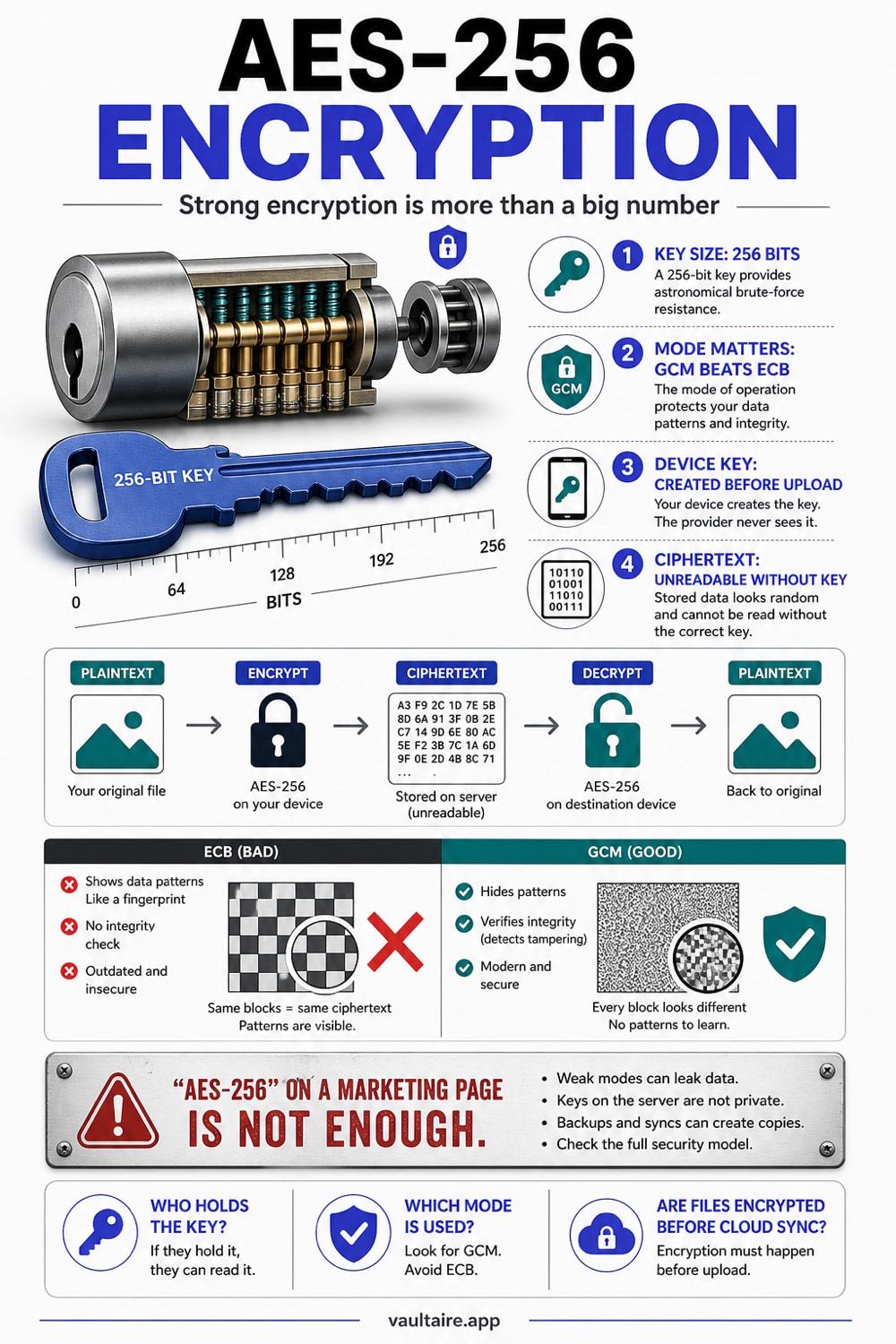
AES-256 is a symmetric block cipher: the Advanced Encryption Standard run with a 256-bit key. One key both encrypts and decrypts. It processes data in 128-bit blocks over 14 rounds, and NIST standardized it as FIPS 197 in 2001.
The name is three facts stacked together. AES names the algorithm, chosen by NIST in 2001 from the Rijndael submission. 256 is the key length in bits, which sets how many keys a brute-force attacker must try. A mode such as GCM or CBC, usually written after the name as AES-256-GCM, decides how blocks chain together and whether the ciphertext is checked for tampering. AES-256 alone tells you the cipher and the key size. It does not tell you the mode, and it does not tell you who holds the key.
AES-256 is the Advanced Encryption Standard with a 256-bit key, standardized by NIST as FIPS 197 in 2001. It is the symmetric encryption algorithm used by the U.S. government for classified information, by banks for financial transactions, and by security-focused applications for protecting data at rest and in transit. AES-256 has 2^256 possible keys -- a number larger than the estimated count of atoms in the observable universe. No known attack reduces this key space to a computationally feasible search.
This guide explains what AES-256 actually does, why the key size matters, what the different modes mean (ECB, CBC, GCM), and what to look for when an app claims to use AES-256 encryption.
What AES Actually Does
AES is a symmetric block cipher. "Symmetric" means the same key encrypts and decrypts. "Block cipher" means it processes data in fixed-size blocks of 128 bits (16 bytes).
The algorithm takes your data (plaintext), combines it with a key, and produces scrambled output (ciphertext) through a series of mathematical transformations. These transformations -- substitution, shifting, mixing, and key addition -- repeat for a fixed number of rounds. AES-256 uses 14 rounds.
Each round applies four operations:
- SubBytes: Each byte is replaced using a fixed substitution table (S-box), introducing non-linearity.
- ShiftRows: Bytes in each row are shifted by different offsets, spreading data across positions.
- MixColumns: Columns are mixed through matrix multiplication in a finite field, diffusing changes across bytes.
- AddRoundKey: The round key (derived from the main key) is XORed with the data.
After 14 rounds, the plaintext is thoroughly scrambled. Reversing these operations with the correct key recovers the original data. Without the key, the ciphertext is indistinguishable from random noise.
Why 256 Bits Matters
The "256" in AES-256 refers to the key length: 256 bits. This determines the number of possible keys an attacker must try to break the encryption by brute force.
| Key Size | Possible Keys | Time to Brute-Force (1 trillion guesses/sec) |
|---|---|---|
| 56-bit (DES) | 7.2 x 10^16 | ~20 hours |
| 128-bit (AES-128) | 3.4 x 10^38 | 10^13 years (10 trillion years) |
| 256-bit (AES-256) | 1.16 x 10^77 | 10^51 years |
For context: the universe is approximately 1.38 x 10^10 years old. Brute-forcing AES-256 would take roughly 10^41 times longer than the age of the universe, even at a trillion guesses per second.
AES-128 is already computationally infeasible to brute-force. AES-256 provides an additional margin against future advances in computing, including quantum computing. Grover's algorithm (a quantum computing attack) effectively halves the key length -- reducing AES-256 to the equivalent of AES-128, which is still infeasible. AES-128 would be reduced to 64-bit effective security, which is potentially vulnerable. This is why security-critical applications prefer AES-256.
AES Modes: Why They Matter
AES by itself only encrypts one 128-bit block at a time. For real data (photos, documents, videos), you need a "mode of operation" that handles data larger than 16 bytes. The mode determines how blocks are chained together and has significant security implications.
ECB (Electronic Codebook) -- Do Not Use
Each block is encrypted independently with the same key. Identical plaintext blocks produce identical ciphertext blocks. This leaks patterns in the data. The classic demonstration: encrypting a bitmap image with ECB preserves the image's structure in the ciphertext, making the content recognizable. ECB is included in the standard but should never be used for data that has structure or repeating patterns (which includes virtually all real-world data).
CBC (Cipher Block Chaining) -- Legacy
Each block is XORed with the previous ciphertext block before encryption. This eliminates the pattern leakage of ECB. CBC was the standard mode for decades but has been superseded by GCM for most applications. CBC requires a random initialization vector (IV) and does not provide built-in authentication (you cannot detect if the ciphertext has been tampered with).
GCM (Galois/Counter Mode) -- Current Standard
GCM combines counter-mode encryption with Galois field authentication. It provides authenticated encryption: it encrypts the data AND produces an authentication tag that detects any modification to the ciphertext. If a single bit is changed, decryption fails rather than producing corrupted plaintext.
NIST standardized GCM in SP 800-38D (2007). It is the recommended mode for new implementations.
AES-256-GCM is AES with a 256-bit key in Galois/Counter Mode. This is what security-critical applications should use and what Vaultaire uses for encrypting photo and file contents.
| Mode | Pattern Leakage | Authentication | Current Recommendation |
|---|---|---|---|
| ECB | Yes (severe) | No | Do not use |
| CBC | No | No (requires separate MAC) | Legacy; acceptable with HMAC |
| GCM | No | Yes (built-in) | Recommended for new implementations |
What AES-256 Means for Photo Storage
When a photo vault app claims "AES-256 encryption," three things should be true:
The file contents are encrypted with AES-256. The raw photo data (pixels, metadata, thumbnail) is transformed into ciphertext using a 256-bit key.
Each file uses a unique initialization vector (IV). If two identical photos are encrypted with the same key, the ciphertext should be different. This requires a unique IV per file. Without it, statistical analysis can reveal patterns.
The mode provides authentication (GCM or equivalent). Without authentication, an attacker could modify the ciphertext without detection. The decrypted result would be corrupted data rather than an error.
What "AES-256" on a Marketing Page Does Not Tell You
AES-256 is necessary but not sufficient. Several critical factors determine whether the encryption actually protects your data:
Key derivation matters. How is the 256-bit key generated? If it is derived from a 4-digit PIN using a weak KDF, the effective security is 4 digits (10,000 combinations), not 256 bits. A strong implementation uses PBKDF2 with a high iteration count or Argon2 with appropriate memory and time parameters. Vaultaire uses PBKDF2 with HMAC-SHA512 and 600,000 iterations to derive a local vault key from the chosen 5x5 pattern and a device salt. PBKDF2 makes each guess more expensive; it does not raise the pattern's entropy to 256 bits.
Key storage matters. Where does the key live? If the key is stored in plaintext in the app's sandbox, malware with file access can read it. Apple's Secure Enclave supports specific nonexportable key operations, not arbitrary app-supplied AES keys. Symmetric-key designs may instead rely on Keychain and Data Protection, so documentation should name the exact API and protection class rather than saying only "hardware-backed."
What gets encrypted matters. Some apps encrypt file contents but leave file names, thumbnails, and metadata unencrypted. A forensic examiner might not see your photo, but they can see "vacation-beach-2025.jpg" in the file listing. Comprehensive encryption covers metadata separately.
Key lifecycle matters. How long does decrypted key material remain available? Vaultaire drops its active vault and master-key state when it locks or closes and requires a fresh unlock. Symmetric key bytes necessarily exist in app memory while a vault is open, and Swift and iOS do not let an app prove that every transient copy was overwritten.
AES-256 in Practice: Who Uses It
| Entity | Use Case | Mode |
|---|---|---|
| U.S. government (NSA) | Classified information | GCM (or CTR with separate authentication) |
| Apple (iCloud ADP) | iCloud end-to-end encryption | GCM |
| Signal | Message encryption | CBC (with HMAC for authentication) |
| Banks | Financial transaction encryption | GCM |
| 1Password | Password vault | GCM |
| Vaultaire | Photo and file vault | GCM |
| VeraCrypt | Disk encryption | XTS (optimized for disk blocks) |
Common Misconceptions
"Military-grade encryption" means nothing specific. Marketing pages use this phrase because it sounds impressive. AES-256 is used by militaries. So is AES-128. The phrase does not tell you the mode, key derivation, key storage, or what data is actually encrypted.
"256-bit encryption" might not mean AES-256. Other ciphers also use 256-bit keys (ChaCha20, Twofish, Serpent). Check which algorithm is specified. AES-256-GCM is the current standard.
AES-256 does not protect against a weak password. If your password is "1234" and the key derivation is weak, the encryption is effectively 4-digit security regardless of the cipher strength. The chain breaks at the weakest link.
AES-256 does not protect data in use. When you view a photo, it must be decrypted in memory. At that moment, it exists in plaintext in RAM. Proper implementations minimize this window and wipe decrypted data promptly.
Frequently Asked Questions
What does AES-256 stand for?
Advanced Encryption Standard, run with a 256-bit key. AES is the cipher NIST standardized as FIPS 197 in 2001, after selecting the Rijndael design. The 256 is the key length in bits. A suffix such as AES-256-GCM adds the mode of operation, which is a separate choice from the cipher and the key size.
Can AES-256 be cracked?
No known attack cracks AES-256 by reducing the full key space. The best known attack (a biclique attack by Bogdanov, Khovratovich, and Rechberger, 2011) reduces AES-256 from 2^256 operations to 2^254.4 -- a theoretical improvement that is computationally meaningless in practice. AES-256 remains unbroken.
Is AES-256 quantum-resistant?
Substantially, yes. Grover's quantum algorithm halves the effective key length: AES-256 becomes equivalent to 128-bit security against quantum attacks. AES-128 would be reduced to 64-bit effective security, which is potentially vulnerable. A Grover search against AES-256 would still need about 2^128 operations, which is not practical.
What is the difference between AES-128 and AES-256?
AES-128 uses a 128-bit key (10 rounds). AES-256 uses a 256-bit key (14 rounds). Both are considered secure against current attacks. AES-256 provides a larger margin against future advances, particularly quantum computing. AES-256 is approximately 40% slower than AES-128 due to the additional rounds, but hardware acceleration makes this negligible on modern devices.
Does AES-256 encryption slow down my phone?
Not perceptibly in normal use. Modern Apple processors provide hardware acceleration for AES through system cryptographic libraries. That does not mean an app's AES operation runs inside Secure Enclave. Time still depends on file size, device, storage, and implementation, so a security claim should rely on measurements rather than a universal millisecond figure.
How do I know if an app really uses AES-256?
Check the app's security documentation, not just its marketing page. Look for the specific algorithm and mode, key hierarchy, derivation parameters, exact Keychain or Secure Enclave use, nonce handling, recovery path, and whether metadata is also encrypted. Open-source code and independent audits make those claims easier to verify.
Bottom Line
AES-256 is a widely used symmetric cipher, standardized by NIST, with no known practical attack; a quantum computer running Grover's algorithm would still face about 2^128 work. When evaluating apps that claim AES-256 encryption, look beyond the cipher: check the mode (GCM), the key derivation (PBKDF2/Argon2 with high iteration count), the key storage (a named Keychain and Data Protection class), and what data is actually encrypted (contents + metadata).
Vaultaire uses AES-256-GCM for file content, headers, metadata, indexes, and thumbnails. PBKDF2 with HMAC-SHA512 derives a local vault key from the pattern and a device-wide Keychain salt; that key unwraps a random master key used for file encryption. The symmetric operations run in the app process through CryptoKit, while iOS Keychain and Data Protection protect recovery state when the device is locked. The full hierarchy is documented in the security model.