Plausible Deniability in Apps: What It Is and Why It Matters
Plausible deniability means hidden data's existence cannot be proven.
Plausible deniability in encryption is a storage property that lets a user disclose one data set without leaving a structural artifact that proves another data set exists. The claim must name its threat model: a static image of a properly padded encrypted store is different from a live, compromised device, cloud-service metadata, or copies held elsewhere. This is more than a hiding feature. It depends on the encryption, layout, padding, and operational design working together.
This guide explains how plausible deniability works in apps, the difference between genuine cryptographic deniability and cosmetic decoy modes, real-world scenarios where it matters, and how to evaluate deniability claims.
What Plausible Deniability Means in Encryption
In everyday language, plausible deniability means you can credibly deny something. In storage cryptography, the useful target is narrower: an examiner of the encrypted store should not be able to distinguish concealed content from unused padded space within the stated threat model. No app can extend that promise to an already-open vault, recorded input, external copies, or every form of device compromise.
The concept originated in disk encryption. TrueCrypt (and its successor VeraCrypt) pioneered the hidden volume: an encrypted volume within another encrypted volume. One password reveals the outer volume with innocuous files. A different password reveals the inner hidden volume with sensitive files. A forensic examiner cannot determine whether a hidden volume exists because the unused space in the outer volume is filled with random data that is indistinguishable from encrypted data.
For apps, plausible deniability means that different credentials (passwords, PINs, patterns) open different data sets, and there is no metadata, registry, configuration flag, or structural artifact that reveals the existence of additional data sets.
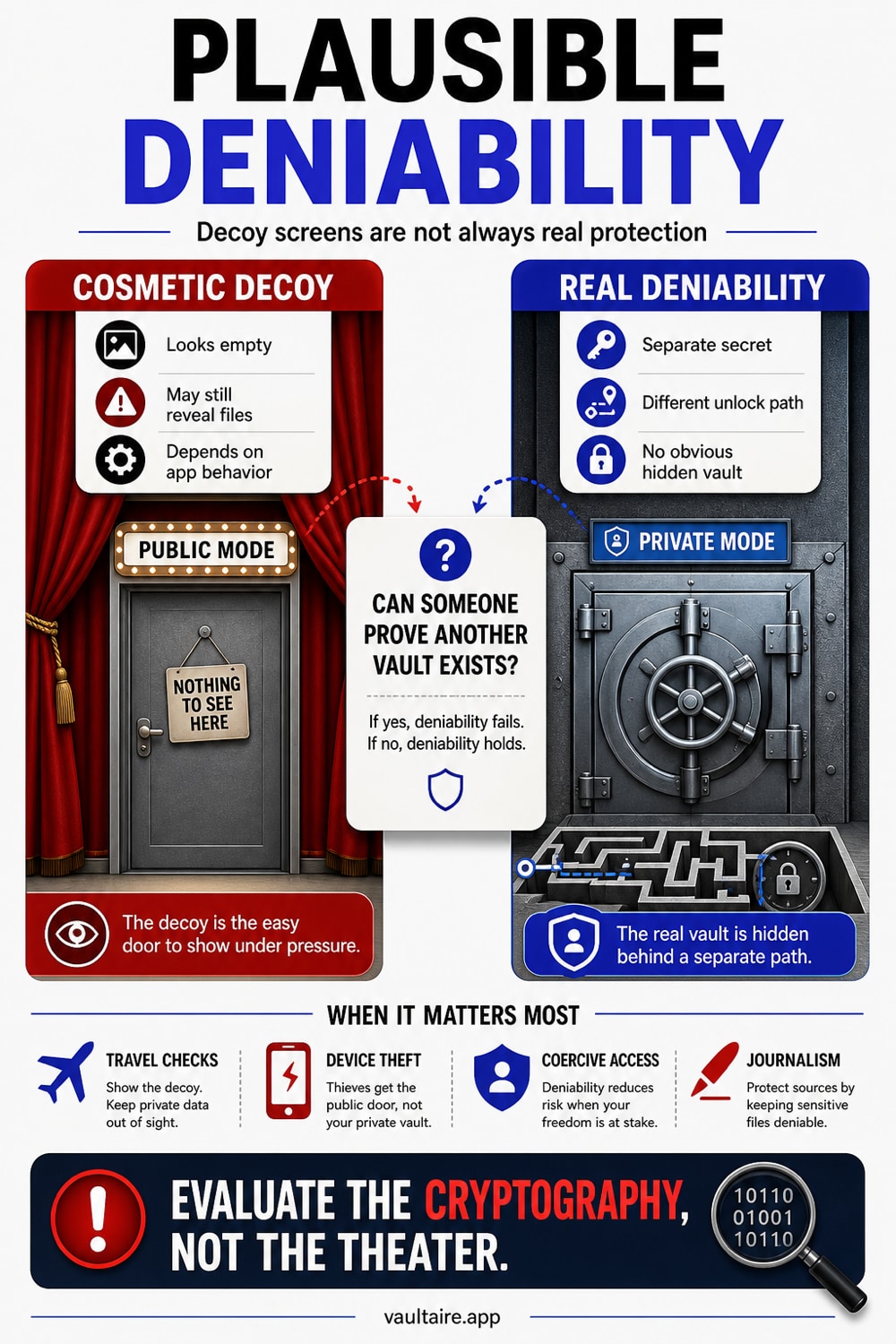
Genuine Deniability vs. Cosmetic Decoy Modes
This is the critical distinction that most apps get wrong.
Cosmetic Decoy Mode (Not Real Deniability)
Many vault apps offer a "decoy" or "fake PIN" feature. You set a secondary PIN that opens a separate space with different photos. The problem: these apps typically store a boolean flag, a database entry, or a configuration file indicating that a decoy mode exists and is configured.
A forensic examiner who understands the app can find this flag. Finding a configured decoy mode proves that hidden data exists. The deniability is cosmetic -- it works against a casual snoop but fails under forensic examination.
Signs of cosmetic deniability:
- The app has a "decoy mode" toggle in settings
- A configuration file stores whether decoy mode is enabled
- A database table lists vault IDs with type indicators (primary/decoy)
- The app's storage structure changes when decoy mode is turned on
- Uninstalling and reinstalling the app reveals different behavior when decoy mode was configured
Genuine Cryptographic Deniability
Genuine deniability is an architectural property, not a feature toggle. The encrypted storage must be designed so that:
Alternate credentials disclose only their own data set. The system does not keep a separate decoy flag that identifies one credential as camouflage. Invalid credentials can fail, but that failure must not reveal whether an undisclosed data set exists.
No vault registry exists. The app cannot enumerate how many vaults exist. There is no count, no index, no list of vault IDs. A forensic examiner examining the app's storage finds an undifferentiated pool of encrypted data.
No configuration flags reveal hidden vaults. There is no boolean, no database entry, no preference file that indicates whether additional vaults exist.
Storage is padded. The total storage consumed does not change based on the number of vaults or files. Without padding, an examiner could estimate the number of vaults from the total encrypted data size versus the visible content.
Encrypted data is indistinguishable from random noise. There are no file boundaries, no headers, no structural markers that reveal where one vault's data ends and another begins.
| Property | Cosmetic Decoy | Genuine Deniability |
|---|---|---|
| Separate data per credential | Yes | Yes |
| No vault registry | No (database tracks vaults) | Yes |
| No configuration flags | No (decoy toggle stored) | Yes |
| Storage padding | Rarely | Yes |
| Conceals alternate storage in a static image | No | Yes, within the stated storage threat model |
| Architectural vs. feature | Feature toggle | Architectural property |
Real-World Scenarios Where This Matters
Plausible deniability is not a theoretical concern. It addresses documented, recurring real-world situations.
Border Crossings
At a border crossing, an examiner may inspect a device and ask for credentials. If a design actually provides storage-level deniability, one credential can disclose an innocuous data set while a static image lacks a structural marker that distinguishes concealed content from padding. Vaultaire’s current storage layout, which reveals the vault count, does not provide that guarantee to an examiner with app-container access.
Domestic Abuse and Coercive Relationships
Someone in an abusive relationship may need to store evidence (photos of injuries, threatening messages, legal documents) on a device that the abuser monitors. If the abuser demands to see the vault, the user can open a vault with non-sensitive content. Without genuine deniability, a "decoy mode" flag in the app's configuration would reveal the existence of hidden content.
Device Theft
A thief with technical skills might attempt to extract data from a stolen phone. A properly padded deniable store aims to conceal how many data sets occupy the pool, although total allocation, device state, backups, and operational traces still belong in the threat model. Vaultaire currently encrypts contents but exposes one countable storage directory per configured vault.
Legal and Journalistic Protection
Journalists protecting sources, lawyers protecting client files, and activists in authoritarian regimes face scenarios where device contents can be compelled. Genuine deniability provides a credible defense against data seizure.
What Vaultaire Implements Today
Vaultaire implements pattern-separated access and a normal interface with no visible vault list. Those properties help during ordinary app use, but they do not meet every requirement in the genuine-deniability checklist above.
Configured patterns open separate encrypted vaults. PBKDF2 derives a vault key from the pattern and a device-wide salt. A configured key authenticates its encrypted index and unwraps a random master key. An unconfigured pattern shows an empty state rather than an "incorrect pattern" message.
The local format is enumerable. Vaultaire stores one vault_index_<locator>.bin root file per vault, plus a storage directory for each real vault. The names do not reveal the pattern or vault name, but someone with app-container access can count the directories. AES-GCM authentication also provides an offline test for candidate vault keys.
Local storage is not constant-size. File content and metadata are encrypted, and cloud backup chunks use size padding and decoy records. Root files sit in a pool with cover files, but each real vault also has its own storage directory, so the directory count and total storage expose structure.
Recovery and duress state exists. Vaultaire keeps recovery information in an AES-GCM encrypted Keychain database. Duress mode removes local indexes and recovery mappings for non-duress vaults and isolates that device from sync. It does not erase cloud backups, copies on peer devices, or every shared encrypted blob, and completion time depends on the local work performed.
Vaultaire therefore provides interface compartmentalization and encrypted storage, not information-theoretic proof that no additional vault exists. A future fixed-capacity catalog with indistinguishable real and dummy slots would be required to hide the local vault count from an offline app-container snapshot.
How to Evaluate Deniability Claims
When an app claims plausible deniability, ask:
- Is there a "decoy mode" toggle? If yes, it is cosmetic. A forensic examiner can find the toggle.
- Does the app have a vault list or database? If yes, vault existence is provable.
- Can guesses be verified offline? Authenticated ciphertext can validate a candidate key without a separate password hash. Ask what limits guessing cost and whether the storage layout offers any cheaper key fingerprint.
- Does storage consumption change with vault count? If yes, disk analysis can estimate vault count.
- Can the app enumerate vaults? If the app can show you a list of your vaults, that list exists on the device and is discoverable.
Frequently Asked Questions
Is plausible deniability legal?
Using encryption with plausible deniability is legal in most democracies. There is no law against having encrypted data on your device whose existence cannot be proven. In some jurisdictions (UK under RIPA, Australia under the Assistance and Access Act), authorities can compel disclosure of encryption keys. The legal question is whether compelling disclosure of a key to data whose existence cannot be proven is enforceable. This remains a developing area of law.
Can forensic tools detect plausible deniability?
An examiner who obtains Vaultaire’s app container can detect encrypted storage and count its per-vault storage directories. The vault_index_*.bin root files come in a pool of 64 with cover files, but the directories show which are real. The files do not disclose vault names or plaintext contents, but their count reveals the number of vaults. The current design therefore hides vaults from normal navigation, not from every forensic storage inspection.
Does plausible deniability work against a determined nation-state?
AES-256-GCM provides a strong content-encryption boundary when keys, nonces, and implementation are sound. That does not make Vaultaire’s current storage layout deniable to a nation-state examiner: the local vault count remains visible, and a live compromise can target patterns, keys, previews, or exports while a vault is open. The current feature separates what different patterns open in the interface; it does not promise that a determined examiner cannot prove additional local indexes exist.
What is the difference between plausible deniability and hidden vaults?
Hidden vaults are vaults that are not visible in the app’s normal interface. Strong cryptographic deniability is the separate property that hidden data cannot be distinguished from unused padded storage. Vaultaire currently provides the first property. Its current storage format, which reveals the vault count, does not provide the second against an examiner with app-container access.
Can I use plausible deniability with cloud backups?
Vaultaire writes encrypted backup manifests and padded encrypted file chunks to the user’s private CloudKit database. Random record names, uniform record types, 10 MB chunk padding, and decoy records reduce direct content disclosure. Record count, total volume, timing, and update patterns remain visible service metadata, so cloud backup does not create a constant-size, information-theoretically deniable store.
Bottom Line
Strong storage deniability aims to keep an examiner from distinguishing concealed data from padded free space in a static encrypted store. Most apps that claim this feature offer cosmetic decoy modes with discoverable configuration flags. Meeting the stronger definition requires a precise threat model, no countable vault registry, no revealing configuration flags, stable padding, and encrypted records that do not expose which slots are real.
Vaultaire uses configured patterns to separate encrypted vaults and keeps vault names and contents out of the locked interface. Its current storage layout still exposes the vault count to app-container inspection. Treat that as interface-level concealment backed by authenticated encryption, not as proof that no additional vault exists.