What Is End-to-End Encryption? How It Protects Your Photos
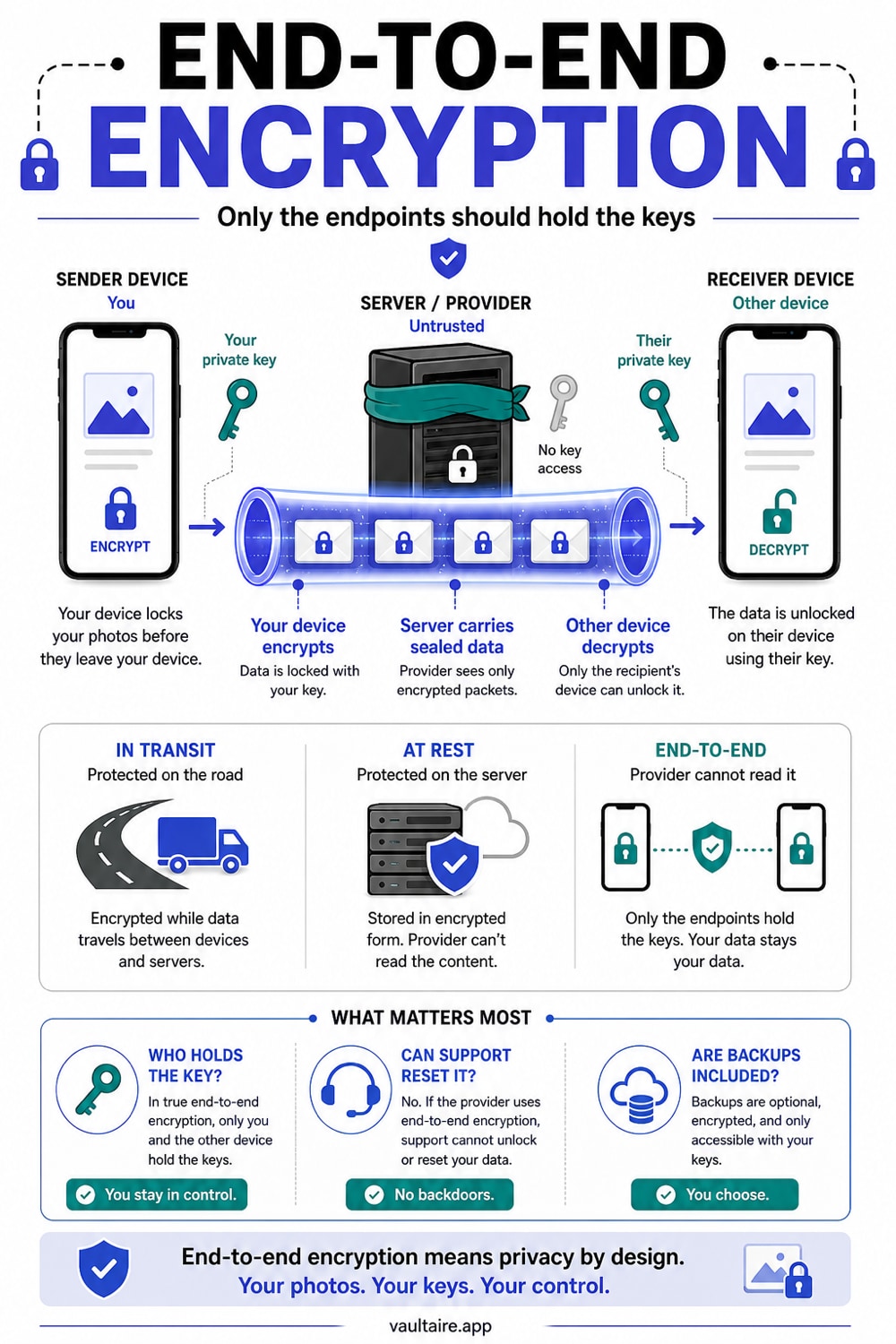
End-to-end encryption keeps readable photo content and plaintext content keys away from the storage provider.
End-to-end encryption (E2EE) is a security model where plaintext is encrypted on one authorized endpoint and decrypted on another. The storage or transport provider does not hold the plaintext content key. That boundary protects content from direct server-side reading, but it does not hide every item of metadata or protect a compromised endpoint, recovery credential, shared recipient, or malicious client update.
For photo storage, end-to-end encryption means your phone encrypts photo contents before upload and the cloud stores ciphertext rather than readable images. Decryption requires a key available through an authorized device or recovery path. File size, timing, account data, sharing relationships, and other metadata may remain visible. This guide explains the boundary and compares common service models.
How End-to-End Encryption Works
The core mechanism involves three stages: key generation, encryption, and decryption.
Key Generation
The user's device generates a cryptographic key. In symmetric encryption (like AES-256), the same key encrypts and decrypts. In asymmetric encryption (like RSA), a public key encrypts and a private key decrypts. Many E2EE systems combine both: asymmetric encryption exchanges a symmetric session key, which then handles the bulk encryption.
Photo vault apps use several key-management designs. Some derive a file key directly from a password; stronger layered designs can use a credential-derived unlock key to wrap a random file key. Vaultaire uses PBKDF2-HMAC-SHA512 to derive a 256-bit vault key from a 5x5 pattern and device-wide salt. That vault key authenticates the encrypted index and unwraps a separate random master key used for file encryption.
Encryption
The plaintext (your photo) is transformed into ciphertext using the encryption key and an encryption algorithm. AES-256-GCM is the most widely used symmetric cipher for this purpose. GCM (Galois/Counter Mode) provides authenticated encryption -- it both encrypts the data and produces an authentication tag that detects any tampering. Each file receives a unique initialization vector (IV), ensuring identical files produce different ciphertext.
Decryption
The recipient's device uses the same key (symmetric) or the matching private key (asymmetric) to reverse the transformation. Without the correct key, the ciphertext is indistinguishable from random data. There is no mathematical shortcut. AES-256 has 2^256 possible keys -- more than the estimated number of atoms in the observable universe.
End-to-End Encryption vs. Other Encryption Models
Not all encryption is end-to-end. The differences determine who can access your data.
Encryption in Transit (TLS/SSL)
Data is encrypted between your device and the server. The server decrypts it upon receipt. This protects against eavesdropping during transmission but leaves the data readable on the server. Every major cloud service uses encryption in transit. It is the baseline, not the standard.
Encryption at Rest (Server-Side)
The server encrypts stored data using keys the server manages. This protects against physical theft of server hardware but not against the service provider, their employees, or legal requests directed at the provider. iCloud, Google Drive, and Dropbox all use server-side encryption at rest. The provider holds the keys.
End-to-End Encryption
Data is encrypted on an authorized endpoint before the storage provider receives it. A sound design keeps the plaintext content key out of the provider's routine server-side custody, so a storage-only compromise or legal demand for stored content yields ciphertext rather than readable photos. The provider may still supply ciphertext and metadata, distribute client software, or operate recovery and sharing systems that must be included in the threat model.
| Encryption Model | Who Holds the Keys | Provider Can Read Data? | Protects Against Provider? |
|---|---|---|---|
| In transit only (TLS) | Server | Yes | No |
| At rest (server-side) | Server | Yes | No |
| End-to-end | Authorized endpoints or recovery holders | Not from stored ciphertext alone | Protects content from provider-held storage keys |
| Provider-blind client-side encryption | Client and documented recovery paths | No plaintext content access by design | Protects content; metadata and client trust remain |
How Photo Storage Services Handle Encryption
The encryption model varies significantly across photo storage services. Some advertise "encryption" without specifying the model, which can mislead users into believing their photos are E2EE when they are not.
iCloud Photos
Apple uses encryption in transit and at rest. Apple holds the encryption keys by default. With a valid legal request, Apple can provide iCloud Photos data. Exception: Apple's Advanced Data Protection (ADP), available since December 2022, adds end-to-end encryption to iCloud Photos. ADP must be explicitly enabled in Settings. When enabled, Apple cannot access iCloud Photos data. Most users have not enabled ADP.
Google Photos
Google uses encryption in transit and at rest with server-side keys. Google holds the encryption keys for all Google Photos data, including Locked Folder contents. Google can comply with legal data requests. Google does not offer an end-to-end encryption option for Google Photos.
Dropbox
Encryption in transit (TLS 1.2+) and at rest (AES-256 with Dropbox-managed keys). Dropbox holds the keys and can access your files. Dropbox has been subject to data breaches (2012, 68 million accounts). Dropbox Vault (a paid feature) adds PIN protection but not end-to-end encryption.
OneDrive
Microsoft uses encryption in transit and at rest with Microsoft-managed keys. Microsoft holds the keys. OneDrive Personal Vault adds identity verification (2FA) but not end-to-end encryption -- Microsoft can still access the data. For enterprise customers, customer-managed keys are available.
Vaultaire
Client-side encryption with provider-held keys excluded. Vaultaire encrypts photos and metadata on the device with AES-256-GCM before any cloud upload. A random master key encrypts vault data. A local vault key derived from the user's pattern and a device salt wraps that master key, while a separate pattern-derived backup key protects private CloudKit backup records. Vaultaire does not operate a content server or receive those keys, so it cannot turn a CloudKit record into plaintext. The app, iOS, and an unlocked device remain inside the trust boundary, and a legal request can still obtain account or service metadata held by the relevant provider.
| Service | Encryption in Transit | Encryption at Rest | End-to-End Encryption | Provider Can Access |
|---|---|---|---|---|
| iCloud Photos (default) | Yes | Yes (Apple keys) | No | Yes |
| iCloud Photos (ADP enabled) | Yes | Yes | Yes | No |
| Google Photos | Yes | Yes (Google keys) | No | Yes |
| Dropbox | Yes | Yes (Dropbox keys) | No | Yes |
| OneDrive | Yes | Yes (Microsoft keys) | No | Yes |
| Vaultaire | Yes | Yes | Client-side encrypted backup, on by default | No plaintext content key; CloudKit metadata remains |
Why End-to-End Encryption Matters for Photos
Photos are uniquely sensitive data. They contain faces, locations (GPS metadata), timestamps, and visual records of private moments. A breach of your photo library exposes more personal information than almost any other data type.
Data Breaches
When a service provider stores photos with server-side keys, a compromise of both storage and its key-management path can expose readable content. With sound E2EE, a storage-only breach yields ciphertext and whatever metadata the service keeps. Endpoint compromise, stolen recovery credentials, malicious client software, and key-service flaws remain separate routes to plaintext.
Legal and Government Access
Service providers can be required to provide records they possess. With E2EE, that may include ciphertext, account information, access logs, record sizes, timing, and sharing metadata rather than readable photo content. Whether a demand can reach a device, recovery method, recipient, or future client behavior is a different legal and technical question.
Internal Access
Employees or attackers with access to provider-managed storage keys may be able to reach server-side encrypted content. E2EE removes that direct storage-key path when the provider lacks plaintext content keys. It does not make insider abuse categorically impossible because providers may control client distribution, account state, metadata, sharing, or recovery components.
Metadata Protection
Some E2EE implementations encrypt only file contents, leaving metadata such as file names and dates unprotected. Vaultaire protects file headers, MIME types, indexes, thumbnails, and other vault metadata with AES-256-GCM authenticated encryption. Stored ciphertext lengths and the number of encrypted index files can still expose structural information to someone with app-container access.
Common Misconceptions About E2EE
"My cloud storage is encrypted, so my photos are safe." Server-side encryption protects against external breaches of the server hardware. It does not protect against the provider itself, legal requests, or insider threats. The provider holds the keys.
"HTTPS means my photos are end-to-end encrypted." HTTPS (TLS) encrypts data in transit between your device and the server. Once the data arrives at the server, it is decrypted. HTTPS is encryption of the pipe, not encryption of the data.
"End-to-end encryption means no one can ever see my photos." E2EE means no one without the key can see your photos. If someone has your password or key, they can decrypt the data. Key management and strong passwords are still essential.
"Apple/Google cannot see my photos." By default, both companies hold the encryption keys for your cloud-stored photos. Apple offers Advanced Data Protection as an opt-in. Google does not offer an E2EE option for Google Photos at all.
How Vaultaire Implements End-to-End Encryption
Vaultaire uses a layered E2EE approach:
- AES-256-GCM encrypts all file contents. Each file gets a unique initialization vector. Authenticated encryption detects tampering.
- PBKDF2 with HMAC-SHA512 derives a local vault key from the user's drawn pattern and device salt. The work factor raises the cost of each offline guess without adding entropy to the pattern. That vault key authenticates the encrypted index and unwraps the random master key used on file data.
- AES-256-GCM for metadata protects file names, dates, dimensions, indexes, and thumbnails under authenticated encryption.
- iOS Keychain and Data Protection protect the device salt and encrypted recovery database. AES-GCM operations and active symmetric keys remain in the app process while a vault is open.
- Provider key separation means Wraxle does not receive a plaintext vault, master, backup, or recovery key. CloudKit backup (on by default), sync and sharing store ciphertext records and encrypted key envelopes, while Apple can still observe service metadata. Vaultaire does not require a Vaultaire identity account.
Vaultaire keeps recovery information, including the pattern, inside an AES-GCM encrypted database stored in iOS Keychain. It is not written to plaintext files or sent to a Vaultaire account service. If no usable pattern, recovery phrase, or already-unlocked device remains, Vaultaire does not hold a provider recovery key that can restore access.
Frequently Asked Questions
Is end-to-end encryption legal?
The legal treatment of encryption, compelled access, and encrypted services varies by jurisdiction and can change. This guide describes the technical model, not legal advice. Check current local law if your use involves border searches, court orders, regulated records, or another high-risk setting.
Can law enforcement break end-to-end encryption?
Attacks rarely need to search the full AES-256 key space. An examiner can target a weak password or pattern, an unlocked endpoint, memory, a recovery phrase, a recipient, a backup, or an implementation flaw. Correctly implemented AES-256-GCM with a random high-entropy key is designed to resist direct key search, but that is only one part of the system.
What is the difference between E2EE and zero-knowledge encryption?
E2EE describes where plaintext encryption and decryption occur and who holds usable content keys. "Zero-knowledge" is often used in product marketing for provider-blind encryption, but it should not be read literally: a service can lack plaintext keys while still seeing ciphertext, account data, sizes, timing, sharing relationships, and other metadata. Evaluate the documented key and recovery paths instead of the label alone.
Does end-to-end encryption slow down my phone?
Modern devices handle AES-256 efficiently with hardware acceleration exposed through system cryptographic libraries. On iPhone, Vaultaire performs AES-GCM in the app process through CryptoKit. Apple's public Secure Enclave APIs are not an arbitrary AES-GCM engine for file encryption. Encryption and decryption overhead depends on file size and device, but it is designed to stay out of the way during normal use.
What happens if I lose my encryption key?
Losing every usable decryption and recovery path makes encrypted data unrecoverable. Many E2EE systems therefore use recovery phrases, trusted devices, recovery contacts, emergency kits, or encrypted key envelopes. Those mechanisms preserve access, but each also becomes part of the security model.
Bottom Line
End-to-end encryption can remove the storage provider's plaintext key path when encryption happens on an authorized endpoint before upload. That is a meaningful protection, not a guarantee about the whole system. Check content-key custody, recovery, metadata, client updates, endpoint security, and sharing before trusting a service with private photos.
Vaultaire implements client-side encryption for iOS. Your photos and vault metadata are encrypted on the device with AES-256-GCM before backup or sync. Vaultaire does not receive the decryption keys or operate a server that can turn those encrypted records into your photos. This provider boundary does not make a compromised or unlocked iPhone trustworthy.